
SPRE National Accelerator Spotlight:
Downtown Eastside CLT
This spotlight is part of the SPRE National Accelerator spotlights series, which highlights organizations across Canada participating in the Accelerator and advancing innovative, community-rooted approaches to affordable housing and social enterprise in their communities.
The Downtown Eastside Community Land Trust (DTES CLT) is a community-governed, non-profit organization based in Vancouver’s Downtown Eastside. Established by a coalition of neighbourhood-serving organizations in 2020, the DTES CLT emerged in response to long-standing housing insecurity and the continued loss of deeply affordable housing in the area. Its central objective is to shift privately owned properties into community ownership, removing housing from the speculative market and stewarding it as long-term community infrastructure.
The DTES CLT’s model is grounded in the premise that removing housing from speculation reshapes long-term stability and affordability. Housing is treated not as a financial asset subject to rising market values, but as a human right and essential aspect of healthy communities. Community ownership brings longevity and continuity, with affordable housing protected for the long term and maintained as a shared resource. This approach provides tenants with housing security by reducing displacement pressures and allowing residents to establish lasting connections to their homes and neighbourhood. Community ownership also alters the flow of resources generated by housing. Rather than being extracted by private landlords, real estate investment trusts, or external investors, revenues are retained and reinvested locally to support maintenance, repair, and long-term stewardship. In this way, housing functions as community infrastructure, with residents collectively stewarding their homes and benefiting from that stewardship over time.
The urgency of this work is shaped by the Downtown Eastside’s housing context. Deeply affordable housing options are limited, and existing housing plays a critical role in maintaining community stability. Single-room occupancy (SRO) buildings, while widely recognized as substandard, serve as homes for many residents and provide levels of affordability that are difficult to replace. When this type of housing is lost, tenants are vulnerable to displacement into homelessness, accompanied by the loss of social, organizational, and community connections. From a system perspective, the loss of existing deeply affordable housing reduces overall supply rather than expanding it.
Within this context, the DTES CLT balances immediate stabilization with longer-term housing objectives. While new housing development is necessary, it is slow and has not occurred at a scale sufficient to replace existing deeply affordable stock. The DTES CLT is prioritizing securing and improving existing buildings by addressing urgent health, safety, and maintenance needs, while pursuing new development at a pace and scale aligned with organizational capacity. Over the longer term, meeting the need for deeply affordable housing will require coordinated action across community organizations and multiple levels of government.
The DTES CLT’s current housing portfolio includes ownership and operational stewardship. The organization is in the process of acquiring the Powell Rooms, a single-room occupancy building that includes a childcare facility. This acquisition reflects an effort to transfer an at-risk privately owned property into community ownership while maintaining existing neighbourhood-serving uses. In addition, the DTES CLT will operate the Keefer Rooms, a provincially owned SRO building, after extensive renovations are completed in 2027. In this role, the DTES CLT will be responsible for day-to-day management and tenant-centred programming. Although ownership remains public, this arrangement places operational control and community governance with the DTES CLT. Together, these roles illustrate an approach that prioritizes decision-making authority, affordability protections, and accountability to tenants over property ownership alone.
Governance is central to the DTES CLT’s institutional design. The organization frames decolonizing housing as a shift away from top-down, extractive systems that concentrate power and decision-making with property owners. In contrast, it emphasizes collective governance, shared authority, and long-term accountability to the community. Its governance structure is rooted in Indigenous leadership, Elders’ guidance, and a Tenants Advisory Committee. Elders and SRO tenants contribute directly to shaping organizational strategies, policies, and priorities, embedding cultural values, relational approaches, and lived experience into decision-making processes, ultimately supporting each building to develop its own culture and sense of community.
This governance framework informs the DTES CLT’s commitment to holistic, tenant-centred housing. Holistic housing is defined as extending beyond physical shelter to include safety, connection, well-being, and belonging. Through partnerships such as the DTES SRO Collaborative, this approach is operationalized through tenant-led initiatives, including food programs, fire safety teams, minor repairs, harm reduction efforts, and other peer-based activities. These initiatives are designed and led by residents who are present in the buildings daily, strengthening safety and quality of life while supporting leadership development and shared responsibility.
The Community Land Trust model holds particular relevance in a neighbourhood shaped by displacement and long-standing exclusion from property ownership. Under prevailing systems, ownership confers disproportionate control over rents, renovations, tenancy, and neighbourhood change. Acquiring land and housing through a Community Land Trust shifts decision-making authority toward residents, establishing durable community decision rights and protecting affordability over time. In this context, reclaiming land and housing through a CLT represents a practical mechanism for advancing community self-determination.
Looking ahead, the DTES CLT seeks to scale its impact by expanding community ownership while keeping governance anchored at the neighbourhood and building level. Growth is guided by commitments to tenant leadership, decolonizing governance, and long-term stewardship. Each building is intended to develop its own tenant governance structures, reflecting local needs and priorities while contributing to shared goals of safety, stability, and community wellbeing.
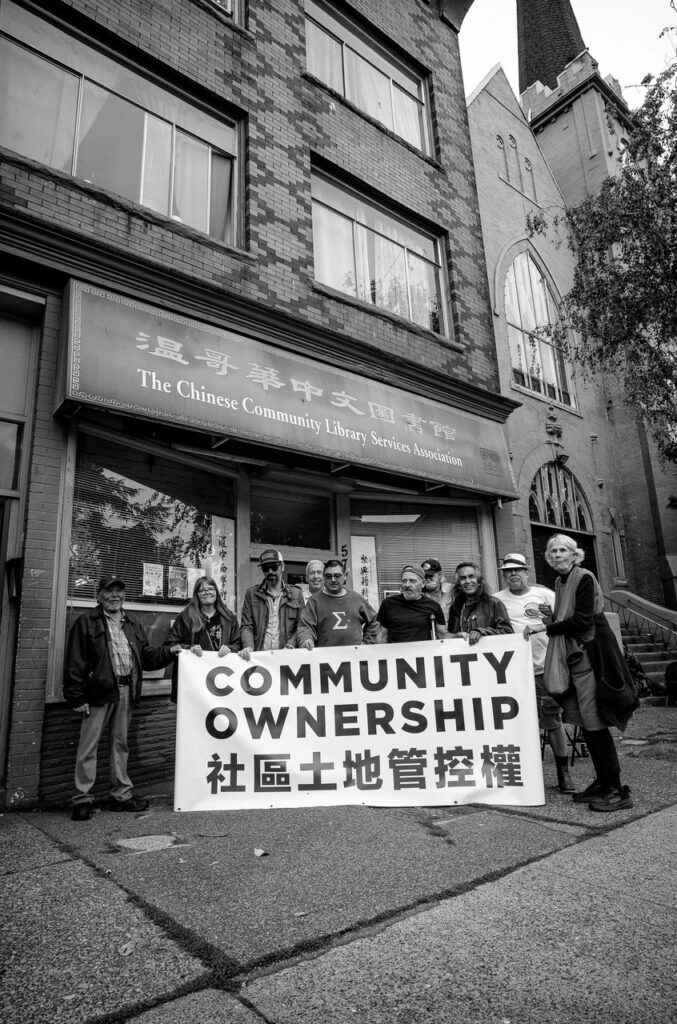
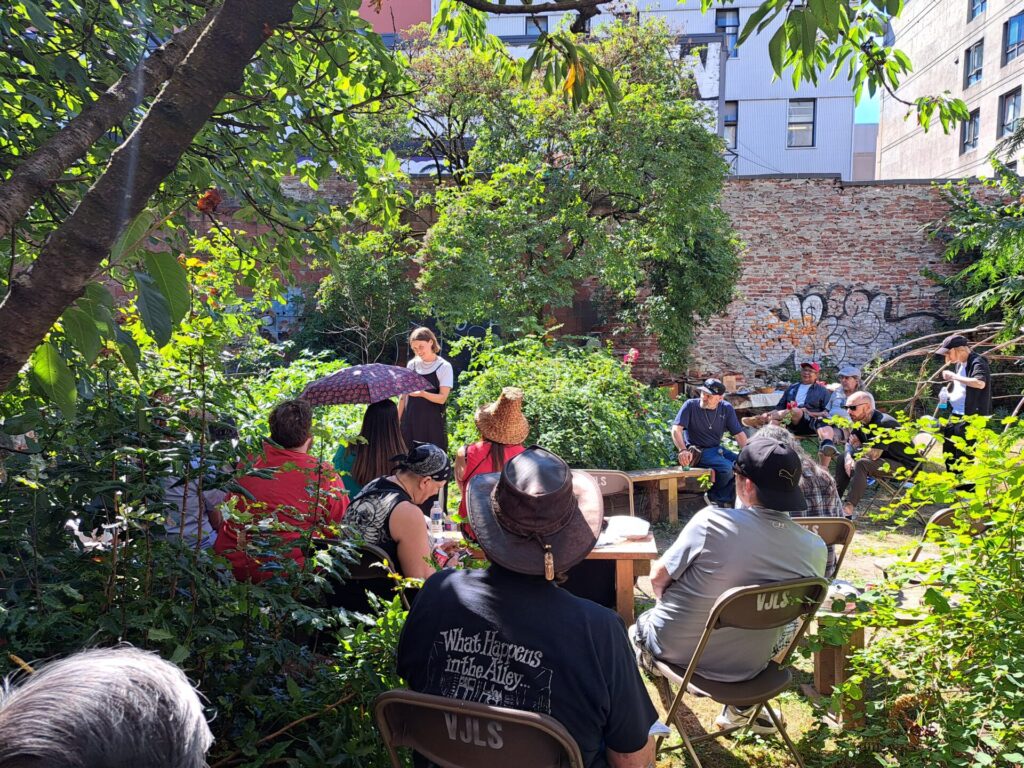
Pictured left: A photo of some members of the Tenants Advisory Committee, Elders Advisory Committee, staff and community members, taken in 2023.