
SPRE National Accelerator Spotlight:
Reception House Waterloo Region
This spotlight is part of the SPRE National Accelerator spotlights series, which highlights organizations across Canada participating in the Accelerator and advancing innovative, community-rooted approaches to affordable housing and social enterprise in their communities.
Reception House Waterloo Region was founded in 1985 when a residential home at 101 David Street was converted into shared temporary housing for refugees. What began as a small community effort to welcome people fleeing conflict to Kitchener-Waterloo has grown steadily over the last thirty years. When the Syrian crisis escalated in 2012, and again when newcomer supports were further jeopardized by the COVID-19 pandemic through the move to virtual settlement services, Reception House expanded to ensure that people arriving in Waterloo Region had a safe and supportive place to begin rebuilding their lives. Today, Reception House serves newcomers and refugees from around the world, with Rohingya, Uyghurs, Nigeriens, Somalians and Eritreans making up the majority of newly arrived groups requiring housing assistance.
Securing housing in Canada has become increasingly difficult for newcomers and refugees over the last two decades, due to an increasingly competitive rental market and rising newcomer discrimination. In addition to providing settlement supports, Reception House supports Government Sponsored Refugees (GARs) upon arrival by managing temporary 21-day stay accommodation in regional federally funded hotels, as well as offering support finding long-term housing. In addition to a competitive rental market, social media has contributed to misinformation about newcomers, making it more difficult to secure rental properties. An increasingly expensive rental market, managing expectations as newcomers realize their picture of the “American dream” will take time to actualize, and discrimination from landlords, are all barriers that the Reception House Housing team navigates while searching for housing for their clients.
To counter these barriers, Reception House has invested in educating landlords on why newcomers and refugees are reliable tenants. The combination of financial assistance available to newcomers and refugees, coupled with an eagerness to maintain secure housing, means that many newcomer tenants pay rent on time and are respectful of neighbours and property. Since starting this advocacy work, many landlords have returned to Reception House requesting more tenant referrals. Over time, Reception House has built up a roster of 300 private and corporate landlords and property managers in Waterloo Region who are eager and willing to rent to newcomers and refugees. In addition to educating landlords, the Reception House housing team provides integration supports that teach newcomers and refugees how to use and care for amenities in Western homes, along with basic information about tenant rights.
Acknowledging the cost to taxpayers of relying on hotels for short-term accommodation, and the need for more affordable housing for families, Reception House is building a six-story building that will offer short-term 21-day government-funded stays, as well as longer-term affordable housing to newcomers and refugees in Waterloo Region. The main floor will offer settlement services, and the remaining five floors will be home to 30 1-4 bedroom units. The project is in pre-development and aims to be shovel-ready in September 2026 and completed by October 2028. The development will be built on 471 Wellington St North, Kitchener, land already zoned for mixed use. The property is owned by the City of Kitchener and leased to Reception House on a 50-year lease. Some of the longer-term units will be available at an Ontario Disability Support Program (ODSP) rate.
This work is enabled by strong partnerships. In addition to leasing the land to Reception House City of Kitchener is waiving property tax and offering some pre-development funding. Experienced development consultants at Maxwell Building Consultants are guiding early plans. Various co-op housing providers are offering knowledge and experience regarding governance and offsetting operating costs.
Even with the support of partners, sustaining operating costs without relying on profit from rentals is challenging. Settlement agencies, like many other nonprofit sectors, are vulnerable to federal budget changes every election. While there is a risk mitigation and contingency plan in place, the development of the building relies on funding from Canada Builds Homes and CMHC. If Reception House is not successful in these funding applications, completing its capital stack will be challenging. Like many non-profits, being fully dependent on public funds creates vulnerability.
For their new housing project, the next stage is focusing on unit design, fundraising for development, and confirming a long-term operations plan for when the building is move-in-ready in October 2027. They’re currently focused on a capital campaign. The Reception House team is also in the early stages of considering culturally informed architecture, noting that they currently serve many families who prefer to sleep together in one room, instead of in individual bedrooms, as is more common in Western homes. Cultural needs, accessibility, and environmentally conscious design are some of the many considerations they’re exploring in the design stage.
All of this work moves toward a single purpose: providing newcomers a stable beginning in a community that welcomes them. Reception House recently launched Home Begins Here, a 2-year capital campaign. The campaign also aims to challenge stereotypes around refugees, government support, and emphasize the many values newcomers and refugees add to their new communities. As Reception House advances this new development and builds on its long history in Waterloo Region, the hope is that people across the community will feel inspired to learn more, stay connected, and support the foundation being laid for the years ahead.

Pictured left: Pamphlets with resources on donations for children and an eviction zine for tenants are available to clients in the Reception House lobby.
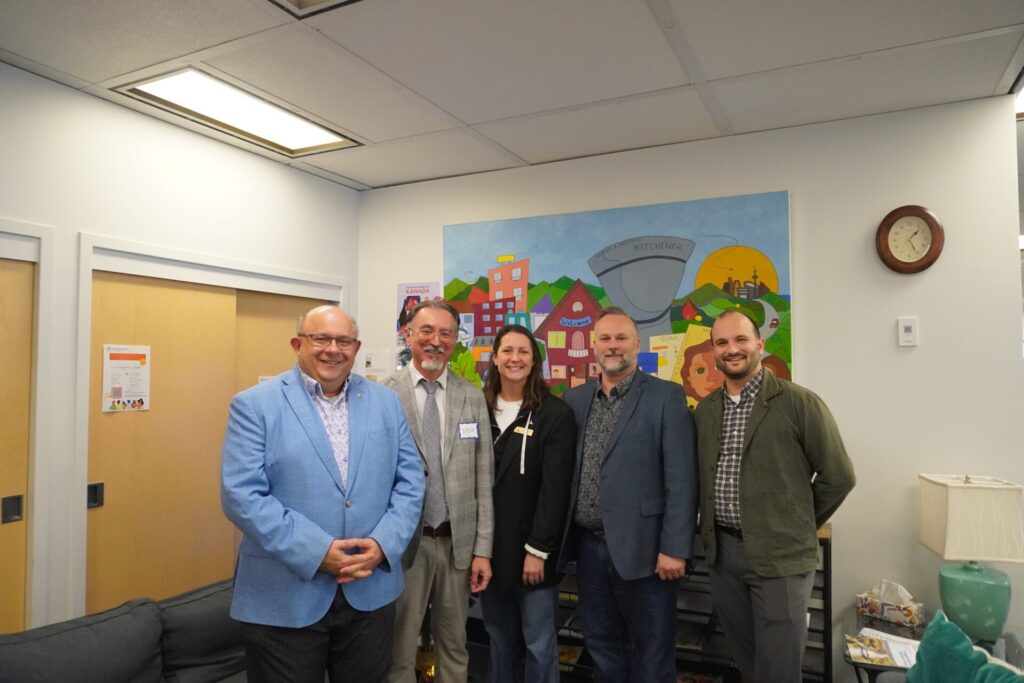
Pictured above: City of Kitchener Mayor and City Councillors post alongside the Reception House CEO following the announcement of the affordable housing project at 471 Wellington St North, Kitchener.
Pictured above: City of Kitchener Mayor and City Councillors post alongside the Reception House CEO following the announcement of the affordable housing project at 471 Wellington St North, Kitchener.