
Blog
The Infrastructure Institute blog features reflections from staff and guest contributors that explore various elements of global urban infrastructure.
Where We Sleep at Night
From The Edges of Belonging: A Narrative of the Urban Housing Crisis in North America
By Raisa Masud
March 2026
It was April 27, 2019, and the fresh scent of spring lingered as we travelled northward in Portland, Oregon. As my research team and I entered Hazelnut Grove, a self-governing tiny house village in Portland, we were invited to sit in on a community meeting. During the meeting, community advocates and a few residents expressed their concerns surrounding the village being relocated due to complaints from neighbourhood NIMBYs.
As we continued our multi-sited research across various metropolis cities in North America (Portland, Detroit, Vancouver, and Toronto), I learned about the critical need for alternative forms of housing to shelter the rapidly growing housing-insecure populations in urban centres. This concern was paired with the continued neighbourhood backlashes and political turmoil. While tiny houses offered one model of housing in temperate and less populated areas, other options, such as modular housing, saw a rise in interest in densely populated regions like the Greater Toronto Area.
In January 2019, the City of Toronto gave an eviction notice to tent city dwellers living under the Gardiner Expressway. 14 days later, the community was swatted and abolished (Lee-Shanok, 2019). Not long after that, a high-end pop-up restaurant named “Dinner with a View” appeared a few blocks away. The concept was designed to excite: each table was situated in a dome-shaped bubble-pod, a kind of tent with clear walls and heating. Waiters moved between the kitchen, housed in a nearby building, and the tented tables, serving food that had been prepared by Top Chef season 4 winner Rene Rodriguez, costing upwards of $600 for a table of four. While the company billed the pop-up as a luxurious dining experience in a highly unexpected setting, anti-poverty activist Yogi Acharya called it “an obscene spectacle” (CBC Radio, 2019). The placement of these individual domes near the site of the abolished tent city was taken as an affront or mockery by many, and the restaurant was heavily protested by anti-poverty activists in the city.
At the time, a group of ethnographers, including myself, were investigating the utilization of tiny houses as a means of providing shelter for housing-insecure communities, knowing some 3500+ men, women, and children slept on the street in Toronto each night. As I travelled to different parts of North America to build on my research, I came to a greater understanding of the contexts in which tiny houses worked. I also came to see several important shortcomings of the model.
In response to Portland’s growing crisis of affordable housing and homelessness, Mayor Charlie Hales declared a “housing state of emergency” in 2015. As of 2021, Portland continues to experience an affordable housing crisis, according to the Government of Portland (GOP, 2021). Experts suggest that the affordable housing crisis has reached a state of “financial collapse” which could only be salvaged through better management, regulatory reforms, streamlined permitting, tax increment financing, and social housing models (Bach, 2025). Tiny houses emerged as an important part of the city’s approach to remedying housing insecurity. The houses are built and financed by the City of Portland (and in partnership with Multnomah County) and mainly managed and operated by residents. My colleagues and I visited seven tiny house villages, and while the form and layout of each village varied, they generally contained around 20 tiny houses or sleeping pods-terms used interchangeably by many, often with a shared communal kitchen, shower, bathrooms, and more.
What intrigued me most was the stark difference between how the city of Portland viewed the tiny house villagers in comparison to the villagers’ self-perception. In an interview with the Housing Program Coordinator for the Portland Housing Bureau, Dr. Uma Krishnan, she described the residents of the tiny house villages as “homeless.” However, she noted that the tiny house villages made it much easier to provide services (healthcare, flu shots, contraceptives, and other social services) to residents who might otherwise be on the streets. This was considered the “productive” side of tiny houses, while there were also several repressive sides to the model. Tiny house villages allowed the city to keep houseless communities out of sight while still having substantial control over the population. During our visit to Dignity Village, we learned that the village residents had a different perspective. They considered themselves sheltered (not homeless) and found comfort in being part of what they referred to as the “dysfunctional families” that got built within the tiny house communities.
Dignity Village was built in 2004 as a self-governing transitional housing community, although some of the residents had lived there for over a decade. One of the residents took me on a tour of the village and showed me the community garden, the communal kitchen, and the computer space, small but significant aspects of the village that made the space more livable. The success and longevity of Dignity Village were instrumental in the acceptance of Tiny Houses in Portland. Dignity Village’s self-governed, long-term (and in some cases, fiercely proud) residents had built a strong sense of community. “There is nothing about us, without us,” said Lisa, the elected co-chair of the Village at that time. She was proud to present the advocacy that her community had practiced in the formation and maintenance of tiny house villages. “We’re as self-governed as anybody can be living in the USA.” Nonetheless, I could not help but notice the juvenile detention center that was located directly behind the village, along with the ongoing traffic of large garbage trucks and construction vehicles. Although the location gave residents more space, it also posed various challenges. For example, the distance from downtown Portland meant that residents had to travel long distances to access basic needs and social services. Meanwhile, other villages, such as Hazelnut Grove, continued to face legal persecutions and threats of relocation.
In early 2021, the City of Portland announced it would “decommission” Hazelnut Grove and relocate the residents due to supposed environmental, fire, and traffic risks and safety concerns at the site (City of Portland, n.d.). While Hazelnut Grove’s social media presence has dwindled since 2021, local news articles recognize that villagers have continued to occupy the space. This constant precarity of occupying space is a huge stressor for village inhabitants, many of whom have had to endure countless police raids and sweeps while sleeping rough. The Tiny House Model works best in responding to urban housing insecurity as a short-term solution, when there is an equal investment towards the establishment of the community by dwellers, neighbours, and, depending on whether it is a governmental or non-governmental entity, the role of the state or a principal organization. In Portland, for example, Portland State University played an integral role as an anchor institution to advance the tiny house movement in their city. Conversely, Reverend Faith Fowler’s theological devotion and efforts in Detroit, MI, built a unit of trust among community members; the concept of Christians supporting those in most need allowed the Cass Community Tiny Houses to flourish through public support. These cases reified that alternative housing models can be successful in tandem.
In comparison, densely populated cities lack the space to accommodate separate dwellings, even if they are “tiny”. The size, layout, and geographic configuration of a city strongly influence what is possible, as does the will of local and state governments and supporting organizations. In 2025, nearly 85,000 people were known to be experiencing homelessness in Ontario, around 20,000 of whom are children and youth, with an 8% overall increase from 2024. Inter-governmental institutions have invested roughly $4 billion in combating homelessness in 2025, yet the statistics depict that an additional $11 billion over the next decade is required to end homelessness (Jones and Casey, 2026).
Modular housing models are being pursued by various players to tackle the affordable housing crisis in Toronto, Ontario. A notable case is 1120-Ossington, a 25-unit supportive housing project. Developed and operated by St. Clare’s Multifaith Housing Society, this project aims to provide people experiencing homelessness with permanent rent-geared-to-income housing. Other community-led organizations and advocacy groups are developing transitional housing projects that have become imperative to ensure safety and dignity for Ontarians. Some of these organizations are participants in the Infrastructure Institute’s Social Purpose Real Estate Accelerator program. At this trying time, collaboration among all levels of government is essential to maximize the impact of housing investments aimed at eradicating homelessness. It is also necessary to include the voices of community players, neighbourhood groups, and, most importantly, those who are impacted by the crisis.
The construction of tiny house villages continues to face several challenges, space and location being the big factors. The NIMBY complex poses a challenge for communities, as in the case of Hazelnut Grove in Portland. The village continues to be contested by neighbours who are intolerant towards the villagers due to their “homeless” status. Others, such as Dignity Village, have already been relocated to a discarded area of the city, out of sight from the rest of Portland. Nevertheless, tiny houses have allowed residents to, in their words, regain their dignity and independence. Though far from perfect, at least, the tiny house model made way for us to gain greater insight into the need for cross-collaboration, advocacy, and challenging the status quo to ensure a safe shelter for all. Ultimately, housing is a human right, and it is in all our best interests to work together and aim to dismantle the systemic barriers that prohibit residents from having a safe place to safely store their belongings, a place to shower and eat, and stay warm during winter nights.
For a deeper look at policies and practices that Canada can implement to tackle the housing crisis, tune into the Good for Cities episode “How to Build Affordable Housing That’s Good for Cities”.
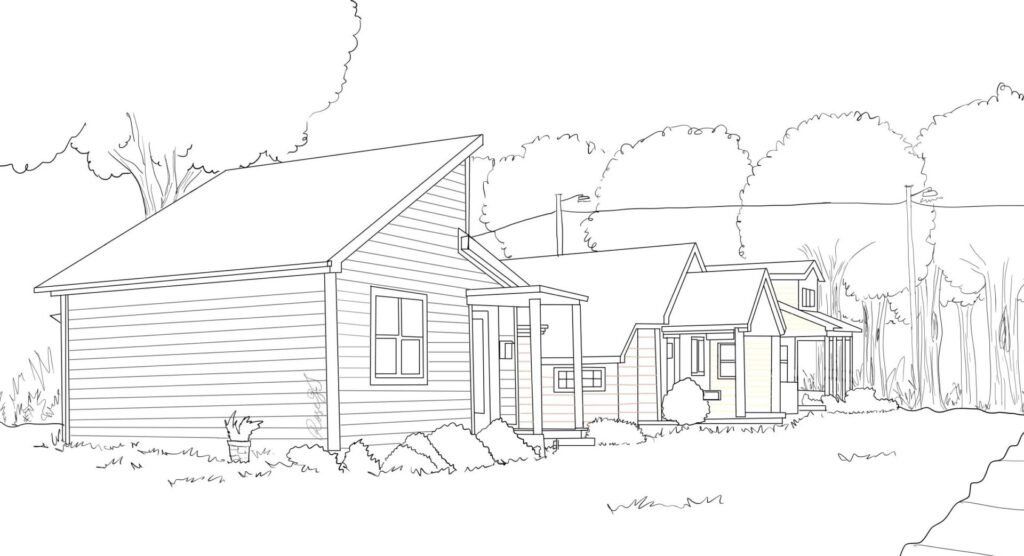
Pictured above: a rendering of Cass Community Tiny Houses in Detroit, Michigan, made by the author.
About the author:
Raisa Masud is a sociocultural anthropologist and serves as Project Lead at the Infrastructure Institute, managing the social purpose real estate programs. Beyond work, Raisa advocates for knowledge mobilization and building resilient communities. Raisa enjoys writing poetry, baking cakes, and spending time with loved ones.
This project was conducted in collaboration with Miguel Waltoo and Natasha Heselden, and led by Principal Investigator Dr. Katie Kilroy-Marac, Professor of Anthropology at the University of Toronto.
References
Bach, J. (2025, December 22). Portland affordable housing is in financial collapse. Can it be salvaged? The Oregonian/OregonLive. https://www.oregonlive.com/business/2025/12/portland-affordable-housing-is-in-financial-collapse-can-it-be-salvaged.html
CBC Radio. (2019, April 2). Posh dome restaurant opens under Toronto expressway weeks after nearby homeless camp eviction. CBC Radio, As It Happens.
https://www.cbc.ca/radio/asithappens/as-it-happens-monday-edition-1.5079615/posh-dome-restaurant-opens-under-toronto-expressway-weeks-after-nearby-homeless-camp-eviction-1.5079628
City of Portland. (n.d.). Portland.gov. https://www.portland.gov
Jones, A., & Casey, L. (2026, January 13). Nearly 85,000 people homeless in Ontario, up 8% in one year: report. CBC News. https://www.cbc.ca/news/canada/toronto/ontario-homelessness-increase-9.7043750
Lee-Shanok, P. (2019, January 11). City issues notices to vacate to those living in tent city beneath Gardiner. CBC News. https://www.cbc.ca/news/canada/toronto/city-issues-notices-to-vacate-to-those-living-in-tent-city-beneath-gardiner-1.4974059
Portland Housing Bureau. (2021). State of housing in Portland 2021: Introduction and executive summary. City of Portland. https://www.portland.gov/phb/documents/introduction-and-executive-summary/download
Snowdon, P. (2019, January 11). City issues notices to vacate to those living in tent city beneath Gardiner. CBC News. https://www.cbc.ca/news/canada/toronto/city-issues-notices-to-vacate-to-those-living-in-tent-city-beneath-gardiner-1.4974059